

Is Your llms.txt Already Stale?
In which I build a freshness check for llms.txt and discover that my tools were the problem.
I’ve been posting a lot of content lately and having a lot of conversations with people in various roles as a result. One message was from someone who I think was in a similar position to a lot of us right now. As I traded messages with them, I realized that because a lot of people are seeing my content right now, this is exactly when I need to write this article. So here was the question, and my answer:
…everyone is in a Wild West AI frenzy, there’s an unspoken “oh they won’t want AI” and I want to show that I am happy to embrace AI and I’m not hostile. Where would you start?
There is a lot of hype going around right now. Some people are talking about some very clever things they’re doing with AI. And those things are getting shared a lot. So with all the noise and sense of frenzy, if you’re not already on the boat, it may feel like you’ve been left behind.
But you haven’t.
Practically everything that anyone is doing with AI right now is new within the last two years. Someone who seems a lot more experienced than you are right now is probably only a few months ahead of you in practice. You have not been left behind. It is not too late to start.
In fact, let me tell you a secret. Someone who was an early adopter a year or two ago might be going around telling everybody who will listen about prompt engineering. Or how they built an entire production-ready system in one shot from a perfect spec that they wrote. That sounds really impressive if you haven’t started using these tools yet. But if you have, you might recognize this as… in some ways, maybe an outdated mental model of what it means to use AI. So those early adopters? I can tell you from what I’m seeing that some of them are getting left behind because they think they understand the way to use these tools.
Since this is all so new, we don’t really know what the impact of these tools looks like in the long run. Techniques that were state-of-the-art two years ago are now… not. Tools that seemed really good when they were rushed to market have been superseded by tools that were able to learn from those early launches and make improvements. As I have been immersing myself more in this space, I have some ideas about things that I think will be sticky… but I guarantee other people have different ideas.
And none of us know which of us is right.
So the best thing you can do is to learn to use today’s tool. Don’t worry too much about what other people have done or what the new cutting edge thing is. Pick something that is relatively stable - as in, more than a few months old, but maybe less than 18 months old - and learn how to use that. That should get you through the next few months, and then it will all change again anyway! We’ll all get to learn fresh again.
The thing that is novel about today’s tools is that - you can interrogate them. AI isn’t like a static API that only takes one input and returns one output. You don’t have to know what methods to call first, how to initialize the thing, how to use the output… if you’re dealing with something like a modern coding agent, you can ask it how to do things.
One of my favorite unlocks was something that, if I recall correctly, CT Smith was talking about last summer maybe? It was the idea that you can ask AI to help you learn how to use tools. You can ask it to give you a basic example. You can ask it to set up a custom tutorial for your task. You can ask it to explain the example or tutorial, or evaluate it after you complete it.
I ask AI to explain things all the time. If I observe it do something that I want to learn more about, I ask it. I look at its outputs and ask it to explain decisions it made or how it implemented something. I ask it to help me brainstorm about things, help me think through edge cases or performance considerations, you name it. If the thing that it is explaining has some implication I need to verify, I ask it to find me a link that backs up what it is saying. And then I look at the link to make sure the content is real, comes from a reasonable source, and actually backs up what the AI says. And probaly also ask it questions about the surface area around the thing, until I’m sure I understand it.
If you approach the AI upskill process as a collaborative learning process, where you can interrogate the tool you’re learning about its capabilities, how and why it’s chosing to do the things it’s doing, and to explain anything you don’t understand along the way - you’re unlocking a super power.
AND you have the comfort of knowing you’re asking all your questions of a talking box that won’t remember what you asked the next time it chats with you. So even if you do think it’s judging you, it has amnesia and that judgement won’t last beyond closing the session!
When I started really digging into this, I tried different tools, and I tried them on different tasks. I picked one tool to try at work. And I picked a different tool to try on a side project. The work I was doing with these two tools was different, and the tools modalities were different, so I had a chance to experiment with what worked better for me in both modality and for the tasks I was working on.
Then I ran out of usage. So I could either try a different tool, or wait for the usage to be available again. I started trying different tools.
I found a tool that I really liked in September, and started paying for an ongoing subscription because I liked it so much at work that I wanted to use it on my personal projects.
And then in October, they changed the pricing model and I found I ran through my usage in about 2 days. I would have to wait the rest of the month for it to reset.
So I tried a different tool.
Now I’m using a tool that works really well for me for the types of tasks I do in my personal projects (Claude Code), but work hasn’t made that available across the org. So I still use the old tool at work. And honestly? I think the old tool that I liked is getting worse. I have found the quality of the outputs diminishing in the work tool, while the work I’m doing hasn’t really been changing.
So, the tool itself matters less than:
And then being willing to do it all again when the tool gets too expensive, too flaky, or the next big thing comes along.
We are all learning how these things work in real time. I learn so much from listening to other people talk about what they’re doing, and thinking about how I can apply that to how I work with these tools. And it’s not just how they use the tools themselves, but also how they learn about how to use the tool.
Some people learn from personal experimentation. Some people learn by watching YouTube videos. Some people learn by sitting with someone else and watching them use the tools. Some people read articles. Some people learn by being taught to use the tools. These - and more - are all valid modalities.
You don’t have to be an expert in these tools. Nobody is. They’re all new tools! You just need to learn about how to learn about the tools. Find what works best for you and look for more of that. Share what you’re doing because I guarantee someone else needs to hear it right now. Share what you don’t like because maybe someone else doesn’t like that, too, and can help you work around it or recommend an alternative. And share what you like because there’s a lot to like about these tools.
Other people who are similarly wondering how to dip their toes in the frenzied waters may hear what you have to say, and find it helpful.
In which I build a freshness check for llms.txt and discover that my tools were the problem.
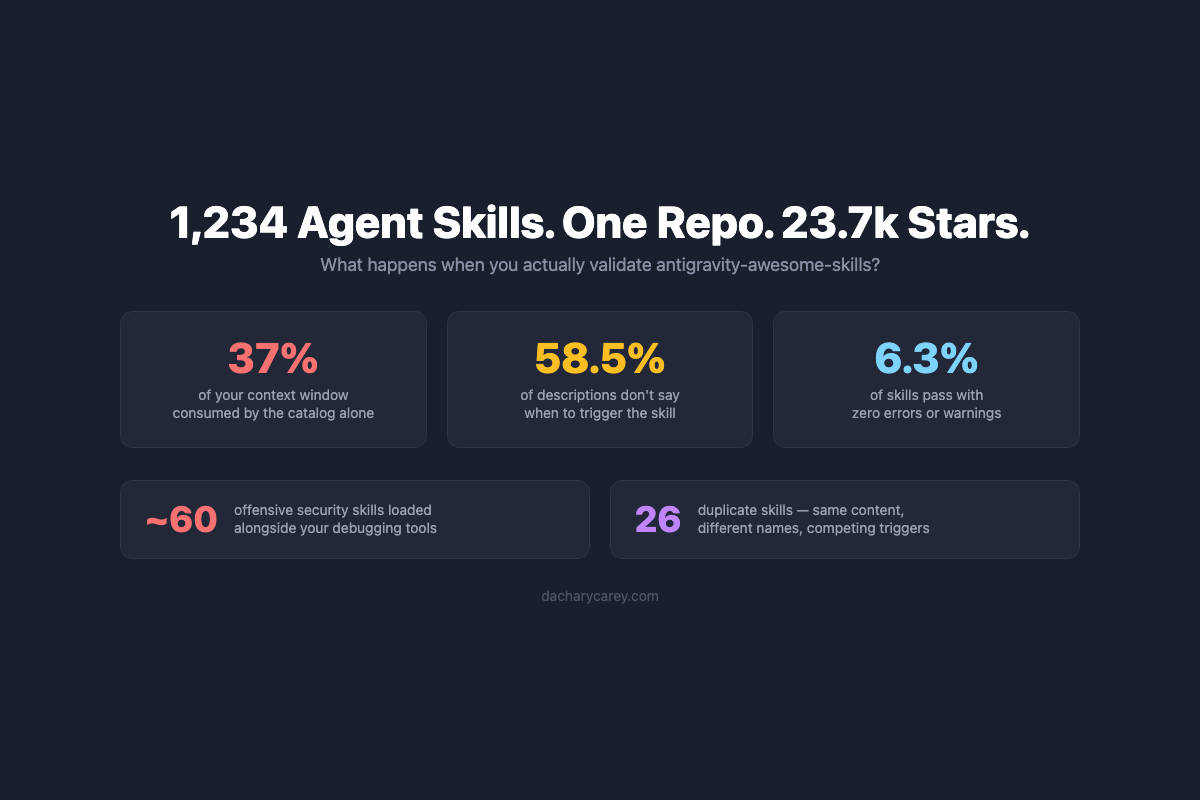
In which I validate a 23.7k-star skill mega repo and discover problems the star count won't tell you.
In which I explain why a vibes-based approach to AI and docs ain't cutting it.